

How Do Search Systems Decide Which Websites Matter?
Millions of pages on the web say much the same thing. So how do Search Systems like Google decide which ones matter? How do you differentiate yours above all others?
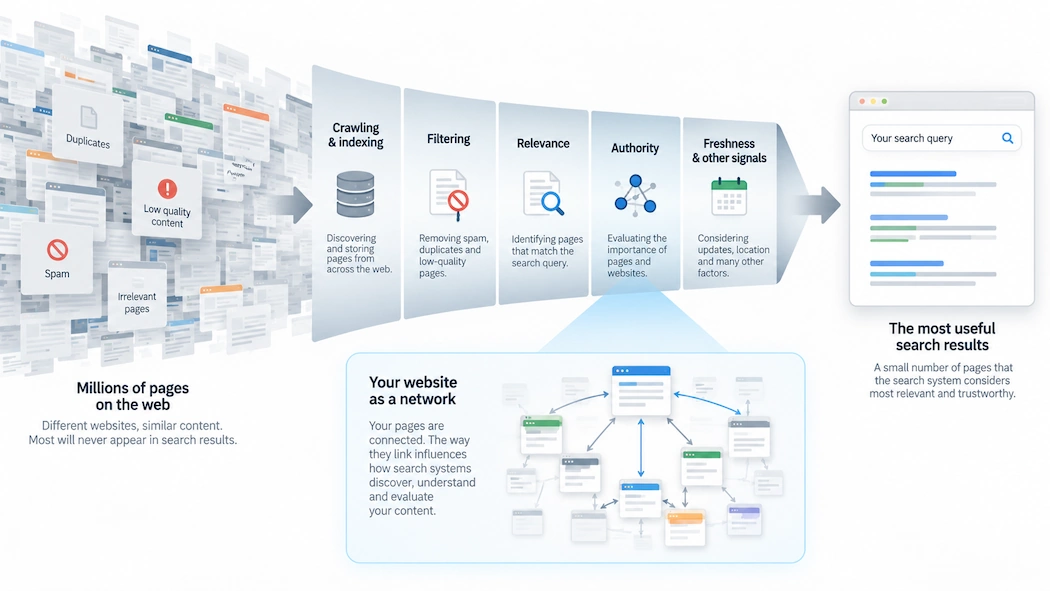
Millions of pages on the web say much the same thing. So how do Search Systems like Google decide which ones matter? How do you differentiate yours above all others?

A website is more than a collection of individual pages. It is a network of connected information in which the relationships between pages help search systems discover content, understand subjects and identify which pages may be important.
Graph theory provides a way to examine these relationships, while Markov chain models help us understand how movement and probability can be distributed across a website’s internal link structure.
By examining these relationships, we can identify whether important pages are receiving less structural emphasis than they should.

You wouldn’t build a house without a foundation and a plan. A website is no different. The pages that matter most to the business shouldn’t be left for Google to discover by chance.
If you want to be found on the web, you need to improve your chances of being discovered for the important pages. Every time someone searches for something, search systems must decide which websites and pages are most relevant to that search. Your website is competing with many others for that opportunity. Being found is therefore not guaranteed. It is a question of probability.

I’m Gordon Barker. I’ve worked in SEO for 30 years, founding my digital agency, Epnet, in South Africa. Now based in the UK, I use the mathematics underpinning search systems to reveal how website structure influences search visibility — and explain the findings in plain English.
These three case studies show how we discovered each website’s underlying foundation, helping owners understand its structure and how to develop it to better reflect their business priorities and strengthen their search visibility. These examples show why understanding a website’s foundation is an essential starting point for evaluating its search visibility.
Example 1.
 Used cars: the site grew, its structure didn’t
A used car dealer was ranking well on page one, then slowly started slipping. Nothing was broken. But the main Used Cars page, the reason the business exists, held under 4% of the site’s structural weight, less than its contact and utility pages.
Example 2.
 Pharmacy UK: Why a Pharmacy Website Remained on Page 2 Despite a Strong Internal Link Network
This UK pharmacy website looked strong on paper. It had 374 indexable pages, more than 30,000 internal links and plenty of content. Yet for the keyword search term it cared about most, “Pharmacy UK”, sat on page 2 of Google. The problem wasn’t a lack of authority. The site treated almost every page as equally important.
Example 3.
 Holiday travel: the most important page was the Privacy Policy
According to our internal link analysis, the Privacy Policy received greater structural prominence than the pages responsible for selling holidays.
You know where you want your business to go. But do you know whether your website’s underlying foundation is helping you get there? An independent structural review can reveal how your website is organised, whether its most important pages and subjects are being reinforced, and where opportunities exist to strengthen its foundation for search visibility.
Three websites, one pattern. In each of these, the pages the business cared about most were the pages its own links treated as least important.
The purpose of a structural website review is to understand whether the relationships between pages are supporting the organisation’s search visibility objectives.
By examining internal linking, structural authority distribution and the probability of movement between pages, we can identify where a website’s architecture reinforces its priorities and where it may be working against them.
The findings provide a basis for informed decisions about the website’s structure, rather than relying on assumptions about individual pages.
See how the review works or view pricing.
See how the review works or see pricing.
Align Your Architecture With Your Commercial Goals
If your search visibility has plateaued despite consistent content investment, the friction is rarely on the page—it is in the network topology beneath it. Send me your website address and a line or two about what’s bothering you. That’s plenty to begin with. Get in touch.
By: T.G. Barker | See how the strategic authority review works | Last reviewed: 15/10/2026.
 Stop Chasing GEO, AEO and the Next Three-Letter Acronym
 Why Anchor Text Matters for Website Owners
 Why Your Website Navigation Cannot Scale — And What Google Does Instead
 Why Server-Side Analytics Is Essential for Identifying AI Crawlers
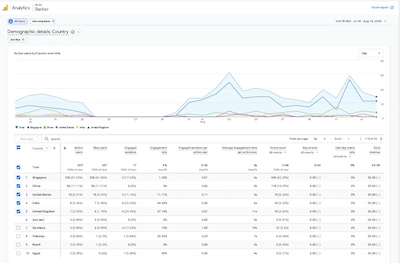 Google analytics and server-side behavioural analysis
 Your Website Needs a Foundation